Companions, summon tickets and what we know
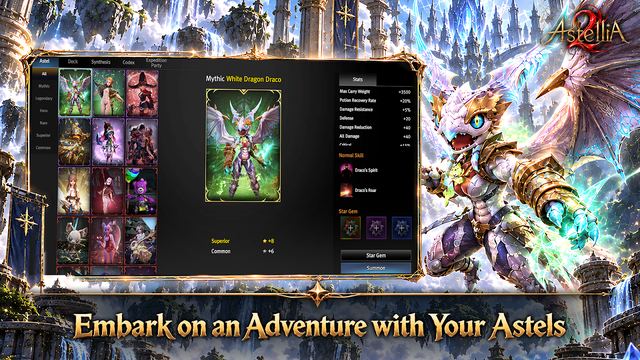
Astels are Astellia 2's signature system, inherited from the 2019 original: summoned companions that fight alongside your character. They are also the part of the game with the least published detail, so this page separates what the developer has said from what players are still working out.

What is confirmed
| Item | Detail | Where it comes from |
|---|---|---|
| What an Astel is | A summoned companion that fights with you | Official contents page |
| One named Astel | Papilla | Official pre-registration rewards |
| Guaranteed summon | One Papilla summon ticket at launch | Official rewards list |
| Summon currency | Standard Astel Summon tickets exist | Official rewards list |
| Related collectible | Avatars, summoned with Avatar Summon tickets | Official rewards list |
That is the whole published surface. There is no official Astel list, no rarity table, no stat sheet and no confirmation of how many exist at launch.
Why the system matters more than the numbers
In the original Astellia, the Astel was half your character: you summoned one, it fought on its own logic, and the pairing decided what content you could clear. The sequel's marketing leans on the same idea — "find your own Astel" is the line on the pre-registration page.
That framing tells you what to expect: collection and pairing, not a single best companion. It also means the launch summon ticket is the most valuable item on the reward list, because it removes one roll of the dice from a system you cannot yet evaluate.
The launch reward, itemised
The pre-registration campaign promised, among other things:
- Gold ×1,000,000
- Seven Star Fragments ×30
- Astra ×100
- Class Selection Avatar Summon Ticket
- Astel "Papilla" Guaranteed Summon Ticket
- Superior Growth Scroll (Account)
- Combat Awakening Scroll (Account)
- Standard Astel Summon ×11
- Standard Avatar Summon ×11
Two of those are Astel-related: the guaranteed Papilla ticket and a batch of eleven standard Astel summons. If you claimed pre-registration rewards, you start with at least twelve Astel pulls and one named companion.
What players are asking
The questions that come up in the first days are consistent, and none of them have official answers yet:
- Can Astels be upgraded or evolved? Not documented.
- Do duplicates matter? Not documented.
- Is there a pity counter on standard summons? Not documented.
- Do Astels have elements or roles? Not documented.
This page will stay honest about that rather than fill the space. When the official site publishes an Astel index, the table above gets a second half.
How to use them in practice
Without published stats, the useful guidance is structural:
Summon early. A companion is free damage and free attention. There is no documented cost to having one out, and there is no reason to save the ticket.
Match the companion to your class weakness. Classes that give up defence — Berserker, Assassin, Mage — want a companion that pulls attention. Classes that give up damage — Knight, Scholar — want one that adds it. That is inference from the class page, not a published rule.
Treat the guaranteed ticket as a known quantity. Papilla is the only Astel the developer has named. Everything else is unknown, which makes a guaranteed result worth more than eleven random ones in a system nobody has mapped.
Astels and the token economy
Astel summons use in-game tickets, and the tokenomics page describes ATRA as an in-game currency with in-game uses that include enhancement, crafting and the market. Whether Astel summoning is one of those uses is not stated.
What is stated: wallet connection is optional, arrives on 19 November, and the token supply, exchange rates and fees are still to be announced. Anyone telling you Astels are an investment on 6 November 2026 is ahead of the documentation.
The one-paragraph summary
Astels are summoned companions, the series' identity system, and at launch you know one name — Papilla — plus the fact that standard summons exist and pre-registration handed out eleven of them. Everything else is waiting on the developer. Play with what you get, do not spend to chase a meta that has not been published, and revisit the system after the first balance patch.
How to evaluate a companion you cannot look up
Until an official Astel index exists, judge what you pull on three visible things rather than on a tier list.
Does it hold attention? The value of a companion to a Berserker, Assassin or Mage is distraction — the classes whose stated weakness is defence. Watch whether enemies turn toward it.
Does it add damage on its own? For the Knight and the Scholar, whose weakness is output, the question is whether the companion kills things while you hold or heal.
Does it survive a boss phase? A companion that dies in the first area attack is a decoration. Boss Subjugation is the honest test.
Write down what you see. With no published stats, your own three-line note per Astel is worth more than any borrowed ranking — and after the first balance patch, it will be the only record you have of what changed.
The summon economy, in one paragraph
Standard Astel summons arrive eleven at a time, which is the batch size the pre-registration reward used, and the shop sells random items according to the store disclosure. That combination — batch summons plus random purchases — is the standard shape of a companion collection system in a Korean mobile MMO. What it means for you is simple: the first eleven pulls are free if you registered, so the decision to spend comes after you have seen what a pull actually feels like.
Source check: official contents page and pre-registration reward list, 6 November 2026.